
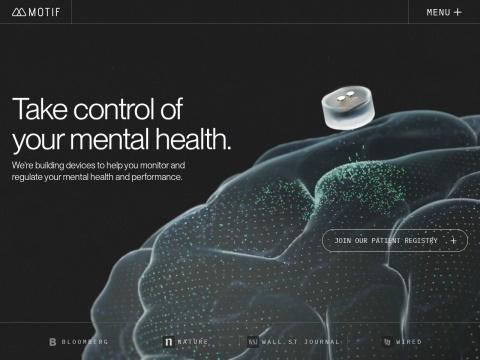
In 2024, Motif Neurotech completed the proof-of-concept first-in-human implant of its millimeter-scale brain stimulator. In 2025, the company launched a patient registry for individuals with treatment-resistant depression. On April 27, 2026, the U.S. FDA granted an Investigational Device Exemption (IDE) for the RESONATE early feasibility study, making Motif the fastest implantAble BCI company to advance from founding to IDE approval with a novel device. The trial will evaluate the XCS System across eight leADINg U.S. medical institutions, with enrollment expected to begin in 2026.
Company Profile (Updated April 2026)
Motif Neurotech is a clinical-stage medical device company headquartered in Houston, Texas, USA. Founded in 2022 through the Rice Biotech Launch Pad at Rice University, the company is pioneering wireless, minimally invasive Neuromodulation therapeutics for mental health. Motif Neurotech has developed the proprietary DOT (Digitally programmable Over-brain Therapeutic) microstimulator, a miniature implantable brain stimulator approximately the size of a blueberry that is designed to restore healthy circuit activity in the brain to treat mental health disorders. Motif products are co-designed by people with lived experience.
Development History:
- 2012: Foundational research began at Rice University under Dr. Jacob Robinson in the electrical engineering department, with support from DARPA, ARPAH, and the NIH BRAIN Initiative
- 2022: Motif Neurotech formally founded in Houston, TX, through the Rice Biotech Launch Pad accelerator
- 2023: Closed initial seed financing; hired Steven Goetz, former Medtronic Neuromodulation veteran, as Chief Technology Officer
- January 2024: Completed USD 18.75 million Series A financing round led by Arboretum Ventures
- 2023-2024: Completed proof-of-concept first-in-human implant of the millimeter-scale brain stimulator; published preprint demonstrating safe and effective brain stimulation without contacting the brain surface
- 2025: Launched patient registry for future research opportunities in treatment-resistant depression
- April 2026: Received U.S. FDA IDE approval for the RESONATE early feasibility study; named one of the fastest implantable BCI companies to reACH this milestone
Core Mission: To build neural devices that give everyone suffering from a mental health condition the opportunity for a better life, making neuromodulation therapy for mental health as common and accepted as pacemakers in cardiology.
2026 Breakthrough: FDA IDE Approval for RESONATE Trial
RESONATE Early Feasibility Study (April 27, 2026)
Regulatory Milestone:
- On April 27, 2026, the U.S. FDA approved the Investigational Device Exemption (IDE) for Motif's RESONATE early feasibility study
- Indication: Treatment-resistant depression (TRD) in adults who have not found relief from two or more medications
- Device: The Motif XCS System, featuring the DOT implant
- Primary Goal: Confirm device and procedure safety over a 12-month period following implantation
- Secondary Endpoints: Track meaningful reductions in depression symptoms using widely used clinical assessments; monitor quality of life, anxiety, and cognitive function
- Principal Investigator: Dr. Sameer Sheth, M.D., Ph.D., Professor of Neurosurgery at Baylor College of Medicine, Director of the Cain Foundation LABS at Texas Children's Hospital, and Co-founder of Motif
- Study Sites: Up to eight leading U.S. medical institutions:
- Baylor College of Medicine (Houston, TX)
- Massachusetts General Brigham (Boston, MA)
- Emory Healthcare (Atlanta, GA)
- UT Health Houston (Houston, TX)
- University of Iowa (Iowa City, IA)
- University of Utah Health (Salt Lake City, UT)
- New York University (New York, NY)
- Brain Health Consultants (Houston, TX)
Core Product: DOT XCS System
DOT Microstimulator Technology
- Size: Approximately the size of a blueberry (millimeter-scale); cosmetically invisible once implanted
- Implantation: 20-minute outpatient procedure performed with minimal training; the device sits in the skull over the brain region well-established as a target for depression treatment without ever exposing or contacting the brain surface
- Power Delivery: Wireless magnetoelectric power transfer technology invented at Rice University; the implant is batteryless and leadless
- External Component: Patients wear a device similar to a baseball cap that wirelessly powers the implant and can record usage data
- Mechanism: Delivers gentle electrical stimulation to activate dysfunctional brain circuits and drive neuroplasticity, creating stronger connectivity within the target network
- Closed-Loop Potential: The system is being developed to monitor brain signals, enabling objective measures to guide personalized therapy
- At-Home Therapy: Patients can self-administer treatment at home, unlike transcranial magnetic stimulation (TMS) which requires daily clinic visits for six weeks
- Safety Profile: Expected to be safer than neural devices that contact brain tissue directly, due to the non-contact epidural placement
Clinical and Preclinical Evidence
- First-in-Human (2023-2024): Intraoperative studies demonstrated that the miniature implant could safely and effectively stimulate the human brain without contacting the brain surface
- Large Animal Studies: 30-day porcine studies demonstrated safe and effective brain stimulation over extended periods
- Foundational Research: Over 10 years of peer-reviewed research from the Robinson and Yang Labs at Rice University, supported by DARPA, ARPAH, and the NIH BRAIN Initiative
Financial and Funding History
Funding Rounds
- Seed Round (2023): Initial seed financing closed (amount not disclosed)
- Series A (Jan 2024): USD 18.75 million raised
- Lead Investor: Arboretum Ventures
- Participating Investors: KdT Ventures, Satori Neuro, Dolby Family Ventures, re.Mind Capital, individual investor Max Hodak, and existing investors Divergent Capital, TMC Innovation, PsyMed Ventures, Empath Ventures, and Capital Factory
- UK Government Grant: Multi-million-dollar award from ARIA's Precision Neurotechnologies programme, sponsored by the UK Department for Science, Innovation and Technology (DSIT)
- Non-Dilutive Funding: Additional support from DARPA, ARPAH, and the NIH BRAIN Initiative
Company Leadership and Team
Executive Team
Dr. Jacob Robinson - Co-Founder, CEO & President:
- Faculty member in the electrical engineering department at Rice University since 2012
- Pioneer in miniaturized, less invasive neurotechnologies
- Led the development of wireless magnetoelectric power transfer technology
Dr. Sameer Sheth - Co-Founder, Chief Medical Officer & Principal Investigator:
- Professor of Neurosurgery at Baylor College of Medicine
- Director of the Cain Foundation Labs at Texas Children's Hospital
- Principal Investigator for the RESONATE study
Dr. Sunil Sheth - Co-Founder:
- Associate Professor of Neurology at UTHealth Houston
- Minimally invasive interventional neurologist
Dr. Kaiyuan Yang - Co-Founder:
- Associate Professor of Electrical and Computer Engineering at Rice University
- Director of Rice's Secure and Intelligent Micro-Systems Lab
- Leads miniaturization and circuit design for efficient wireless data and power transfer
Steven Goetz - Chief Technology Officer (appointed 2023):
- Former Medtronic Neuromodulation veteran
- Brings extensive experience in neurostimulation device development
Nick Halper - Chief Operating Officer:
- Led the company's IDE submission to the FDA
Board of Directors
- Jacob Robinson (Co-founder & CEO)
- Tom Shehab (Managing Partner, Arboretum Ventures)
- Amy Kruse (Chief Investment Officer, Satori Neuro)
- Anthony Arnold (President & CEO, Sensydia Corporation)
Global Market Position and Competition
Market Landscape
Treatment-Resistant Depression Burden:
- Nearly 3 million Americans are estimated to be living with treatment-resistant depression
- TRD is one of the leading causes of disability and suicide in the U.S. and worldwide
- Patients often exhaust multiple medications and therapies without finding lasting relief
Global Neurology Devices Market:
- Projected to reach a valuation of over USD 25 billion by 2034
Primary Competitors
- Neuralink (Elon Musk): Developing BCI implants primarily for paralyzed patients to communicate and use computers; received FDA IDE in May 2023
- Paradromics: Developing high-data-rate BCI for neural recording
- Synchron: Developing endovascular BCI for paralysis and communication
- Abbott: Kicked off pivotal trial in March 2025 for a deep-brain stimulation (DBS) implant for TRD
- Flow Neuroscience: FL-100 headset using transcranial direct current stimulation (tDCS); secured FDA clearance in December 2025
- Traditional TMS: Transcranial magnetic stimulation approved in 2008; requires five treatments per week for six weeks
Competitive Advantages
- Speed to Clinic: Fastest implantable BCI company to move from founding (2022) to FDA IDE approval (2026) with a novel device
- Minimally Invasive: 20-minute outpatient procedure without exposing or contacting the brain, compared to invasive DBS requiring intracranial electrode placement
- Wireless & Batteryless: Patented magnetoelectric power transfer eliminates the need for batteries or transcutaneous leads
- At-Home Therapy: Patients can self-administer treatment via a wearable cap, unlike TMS requiring frequent clinic visits
- Cosmetically Invisible: Implant is hidden within the skull, offering superior patient acceptance
- Closed-Loop Potential: System designed to eventually monitor brain signals and adapt therapy in real time
- Platform Expandability: Same device platform can be repositioned over other brain targets for bipolar disorder, OCD, Alzheimer's disease, and substance use disorder
- Strong Academic Foundation: Over 10 years of peer-reviewed research from Rice University with support from DARPA, ARPAH, and NIH
Technology Roadmap and Expansion
Indication Pipeline
- Primary: Treatment-resistant depression (TRD) - currently in RESONATE feasibility trial
- Exploratory: Bipolar disorder, obsessive-compulsive disorder (OCD), Alzheimer's disease, substance use disorder
- Technical Expansion: Adding multiple implants bilaterally for enhanced stimulation; developing cell-type-specific stimulation for greater precision
2026 Outlook and Strategic Priorities
Clinical and Regulatory Roadmap
- RESONATE Trial: Begin patient enrollment across eight U.S. centers in 2026
- Patient Registry: Continue building registry at registry.motifneuro.tech to identify future trial candidates
- UK Collaboration: Leverage ARIA grant to advance BCI technology with partners including MintNeuro and Rice University collaborators
- Next-Generation R&D: Develop custom integrated circuits with MintNeuro to further miniaturize implants; advance closed-loop capabilities
Manufacturing and Scale-Up
- Scale manufacturing capabilities to support clinical trial demand
- Continue refining the 20-minute outpatient implantation procedure for broader clinical adoption
Contact Information
Headquarters
Address: Houston, Texas, USA
Website: www.motifneuro.tech
Patient Registry
Registry: registry.motifneuro.tech
Investor Relations
Status: Private company
Email: info@motifneuro.tech
Corporate Website: www.motifneuro.tech
Social Media: LinkedIn, X, YouTube, Bluesky
Keywords: Motif Neurotech, DOT, XCS System, brain-computer interface, BCI, therapeutic BCI, neurostimulation, brain implant, depression, treatment-resistant depression, TRD, wireless power, magnetoelectric, Rice University, Jacob Robinson, Sameer Sheth, Sunil Sheth, Kaiyuan Yang, Steven Goetz, Nick Halper, Houston, Texas, FDA IDE, RESONATE trial, mental health, neuromodulation, Arboretum Ventures, KdT Ventures, Satori Neuro, Dolby Family Ventures, ARIA, DARPA, NIH BRAIN Initiative, patient registry, co-designed