
DermaSensor Inc. - AI-Powered Handheld Skin Cancer Detection Pioneer
42026-04-23 13:16:51
DermaSensor Inc. is a private medical technology company headquartered in Miami, Florida, USA. Founded in 2009 by Maurice Ferre and Christopher Dewey, the company has spent over 12 years and tens of millions of dollars developing its proprietary skin cancer evaluation technology. The company is led by CEO and Co-Founder Cody Simmons, who joined in January 2016.
DermaSensor's mission is to equip primary care physicians (PCPs)—the most abundant clinicians in the United States—with an objective, automated tool to better evaluate suspicious skin lesions during routine visits. With approximately 300,000 primary care physicians in the U.S. and only 8% of at-risk Americans reporting recent skin exams, the company addresses a significant unmet need in early skin cancer detection.
Core Mission: To democratize access to effective skin cancer evaluation by enabling quick, non-invasive, point-of-care assessments in primary care settings, ultimately improving early detection and saving lives.
DermaSensor received De Novo marketing authorization from the U.S. Food and Drug Administration, establishing a new regulatory category for software-aided adjunctive diagnostic devices for skin cancer evaluation (Product Code: QZS). This made DermaSensor the first FDA-cleared device that provides PCPs with an automated tool for evaluating all three common skin cancers.
Key Regulatory History:
- 2021: Granted FDA Breakthrough Device Designation, accelerating development and review
- 2022: Successfully completed first-ever FDA pivotal studies for a primary care skin cancer detection device
- 2024: Received FDA De Novo clearance following submission of six clinical studies and two non-clinical studies
- CE Marking: Authorized for sale in the European Union
- Australia: Available for sale in the Australian market
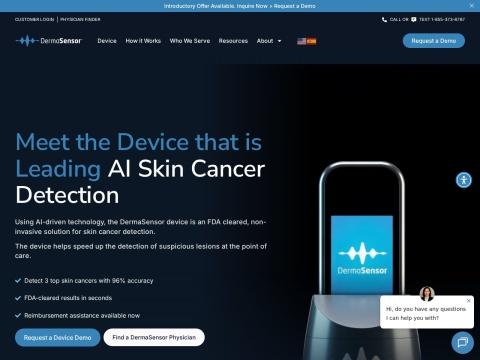
The DermaSensor is a wireless, handheld, point-of-care medical device that uses elastic scattering spectroscopy (ESS) combined with artificial intelligence and mACHine learning algorithms to evaluate skin lesions:
- Non-Invasive Optical Sampling: The device captures cellular and subcellular information from the lesion using hundreds of wavelengths of light, similar to how sonar uses sound
- Spectral Recording: Collects 5 spectral recordings from a lesion in a single scan within seconds
- AI Analysis: The algorithm, developed and validated on more than 20,000 scans, evaluates the optical data
- Result Output: Provides one of two recommendations:
- "Investigate Further" — Indicates elevated risk; patient should be referred to a dermatologist
- "Monitor" — Indicates lower risk; no immediate specialist referral needed
- Risk Score: Positive results include a 1-10 similarity score quantifying the lesion's resemblance to malignant characteristics
The technology was pioneered at Boston University and University College London. The device evolved from an early 30-pound desktop system the size of a microwave to the current handheld, point-and-click form factor designed for seamless integration into primary care workflows.
- Standard Plan: $199 per month for up to 5 patients per month
- Unlimited Plan: $399 per month for unlimited patient evaluations
Conducted across 22 primary care centers with 1,005 patients and 1,579 lesions, led by the Mayo Clinic:
- Overall Sensitivity: 95.5% (superior to PCPs' 83.0% and non-inferior to dermatologists' sensitivity in literature)
- Specificity: 16.6%
- Overall PPV: 16.6%
- Overall NPV: 95.5%
- Device AUROC: 0.7896 (significantly superior to PCP AUROC of 0.7404)
- High-Score (8-10) NPV: 96.6%
- High-Score (8-10) PPV: 39.6%
Cancer-Specific Sensitivity:
- Melanoma: 90.2%
- Basal Cell Carcinoma (BCC): 97.8%
- Squamous Cell Carcinoma (SCC): 97.7%
Evaluated 440 lesions from 311 patients:
- Device sensitivity and accuracy (AUROC) were on par with in-person dermatologists
- Device AUROC: 0.758 vs. dermatologist AUROC: 0.747
- Melanoma NPV: 98.1%
- Melanoma PPV: 47.4% for results between 8-10
Involved 108 primary care physicians evaluating over 10,000 lesions:
- Missed skin cancers cut by half: From 18% to 9%
- Referral sensitivity increased: Physicians became more likely to refer suspicious lesions (from 81% to 94%)
- Reduced false negative referrals and improved overall diagnostic accuracy (AUROC)
Population Representation in DERM-SUCCESS:
- 97.1% White participants
- 13% Fitzpatrick Skin Type V/VI (darker skin tones)
AI Bias Concerns: The limited representation of darker skin tones raises concerns about algorithmic performance across diverse populations. ESS technology relies on light scattering properties, which may vary with melanin content.
FDA Post-Market Requirement: The FDA explicitly requires the manufacturer to complete additional post-market clinical validation performance testing in representative populations to ensure consistent accuracy across all skin types.
Following FDA clearance, DermaSensor strengthened its leadership team:
- Dr. Gary Slatko appointed as Chief Medical Officer. Dr. Slatko brings over 35 years of experience in clinical development, medical affairs, and safety surveillance, including 6 years at the FDA. He previously served as CMO at Aquestive Therapeutics and ParagonRx.
- Ruth Stachura appointed as National Sales Director. She brings over 20 years of medical device industry experience, with a background in nursing and an MBA in Healthcare Management from Johns Hopkins.
- October 2, 2025: Raised $16 million in Series B funding led by Pier 70 Ventures, Kern Venture Group, GenHenn Capital, and other investors, bringing total venture capital raised to approximately $66.7 million
- December 4, 2024: PitchBook records indicate a prior Series B completion on this date
- At the time of the October 2025 funding, the company reported having evaluated approximately 2,000 cases of suspicious skin cancer
- Commercial Launch: Initial U.S. rollout began in Florida and Pennsylvania, with plans for Rapid national expansion targeting primary care practices, large health systems, walk-in clinics, and urgent care centers
- The device was already available in Europe and Australia prior to U.S. launch
- 2023 Edison Silver Award: Winner in the Health, Medical & Biotech category
- April 21, 2026: Named a TiE50 Awards 2026 winner, recognizing promising startups in AI, health, and deep tech at TiEcon 2026
- March 2026: Nature published a commentary stating that FDA's clearance of DermaSensor "marks a pivotal moment in digital health innovation" and highlighted its potential as a milestone for AI-enabled medical device regulation
On October 13, 2025, DermaSensor initiated a voluntary Class 2 recall affecting 9 specific units (out of 343 devices in U.S. commerce). The recall was posted by the FDA on November 21, 2025 (Recall Number: Z-0583-2026).
Root Cause: Process control issue leADINg to potential for certain devices to not meet specifications.
Health Risk: Potential for incorrect results or delay of referral for patients.
Action: The company notified consignees by telephone and follow-up letter, instructed them to examine inventory for affected units, and arranged device correction visits. For devices confirmed to contain the component issue, DermaSensor provided corrected results for affected scans.
Affected Distribution: Maryland, Florida, Arizona, Mississippi, Pennsylvania, New York, Connecticut, and California.
Company Full Name: DermaSensor Inc.
Founded: 2009
Headquarters: 801 Brickell Avenue, Suite 1610, Miami, FL 33131, USA
Company Type: Private Venture-Backed Company
Industry: Medical Devices & Equipment / Diagnostic Equipment / Healthcare IT
Employees: Approximately 31 (per PitchBook estimate)
CEO & Co-Founder: Cody Simmons (joined January 2016)
Co-Founder & Chairman: Maurice Ferre (also CEO and Chairman of Insightec)
Co-Founder & Director: Christopher Dewey
Chief Medical Officer: Dr. Gary Slatko
National Sales Director: Ruth Stachura
Official Website: www.dermasensor.com
Total Funding Raised: Approximately $66.7 million across multiple rounds:
- Series B (Latest): $16 million (October 2, 2025)
- Series B: December 4, 2024 (per PitchBook)
- Series B1: June 2022
- Series B: December 2021
- Series A2: June 2020
- Series A1: March 2020
- Series A1: $5.81 million (December 2018)
- Accelerator/Incubator: February 2018
Key Investors: Pier 70 Ventures, Kern Venture Group, GenHenn Capital, Serial Stage Venture Partners, Wealthing VC Club, Harmonix, SternAegis Ventures, Miami Angels, Ceros Capital, Fred Moll, and others.
- Skin cancer is the most common cancer in the United States, with more cases annually than all other cancers combined
- Approximately 5.5 million new cases each year
- One in five Americans will develop skin cancer by age 70
- 99% of skin cancers are curable if detected early
- Access to dermatology is limited, particularly in rural and underserved areas; more than a third of patients face access limitations
DermaSensor is uniquely positioned in the primary care market because:
- It is the only FDA-cleared automated skin cancer evaluation device designed specifically for non-specialists
- It provides real-time, objective risk assessment at the point of care
- It helps PCPs reduce missed diagnoses and optimize dermatology referrals
- It addresses health equity by extending diagnostic capacity to underserved communities
DermaSensor holds a first-mover advantage as the only FDA-cleared AI-powered handheld device for skin cancer detection in primary care. While dozens of companies have attempted to address skin cancer detection in recent decades, DermaSensor is the first to achieve FDA clearance for an automated tool that evaluates all three common skin cancers.
- Technology: Uses ESS spectroscopy (not just surface photography or visual AI), capturing cellular-level information
- Target User: Specifically designed for primary care physicians, not dermatologists
- Comprehensive Detection: Detects melanoma, BCC, and SCC (not just melanoma)
- Real-Time Results: Provides immediate, point-of-care evaluation without laboratory processing
- Non-Invasive: Completely non-invasive with no tissue removal or biopsy required for screening
- Recall Management: The October 2025 Class 2 recall requires careful quality control and customer trust management
- Market Education: PCPs need training on interpreting and integrating device readings into clinical workflows
- Reimbursement: Insurance coverage and CPT code establishment remain evolving challenges
- Algorithm Equity: Ongoing need to ensure consistent performance across diverse skin tones and populations, particularly Fitzpatrick types V and VI
- Emerging Competitors: Other AI dermatology devices and tele-dermatoscopy solutions are entering the market
- National U.S. Rollout: Expand beyond initial Florida and Pennsylvania markets to achieve nationwide coverage
- Health System Partnerships: Target large integrated health systems and accountable care organizations
- Retail and Urgent Care: Increase penetration in walk-in clinics, urgent care centers, and retail health settings
- Post-Market Surveillance: Continue FDA-mandated post-market studies to track real-world performance across diverse populations, particularly in darker skin tones
- Pipeline Indications: Explore expanded indications and next-generation device enhancements
- Quality Assurance: Strengthen manufacturing and process controls following the 2025 recall
- Health Equity: Expand access to skin cancer screening in underserved and rural communities while addressing algorithmic bias across skin types
- Provider Adoption: Drive adoption among the 300,000+ U.S. primary care physicians
- Evidence Generation: Publish additional real-world evidence and health economic studies demonstrating cost-effectiveness
- International Growth: Leverage CE Marking to expand European and Australian market presence
Address: 801 Brickell Avenue, Suite 1610, Miami, FL 33131, USA
Website: www.dermasensor.com
For additional information, contact the company through its official website or press relations.
Keywords: DermaSensor,skin cancer detection,melanoma,BCC,SCC,basal cell carcinoma,squamous cell carcinoma,elastic scattering spectroscopy,ESS,AI diagnostics,primary care,point-of-care,FDA De Novo,DEN230008,Breakthrough Device,QZS,CE Mark,Cody Simmons,Maurice Ferre,Christopher Dewey,Gary Slatko,Ruth Stachura,Miami,medtech,non-invasive skin cancer test,dermatology AI,DERM-SUCCESS,DERM-ASSESS,health equity,Fitzpatrick skin type,process control recall,TiE50,Edison Award,Nature digital health


Scan the QR code to follow our WeChat Official Account